


Table of Contents
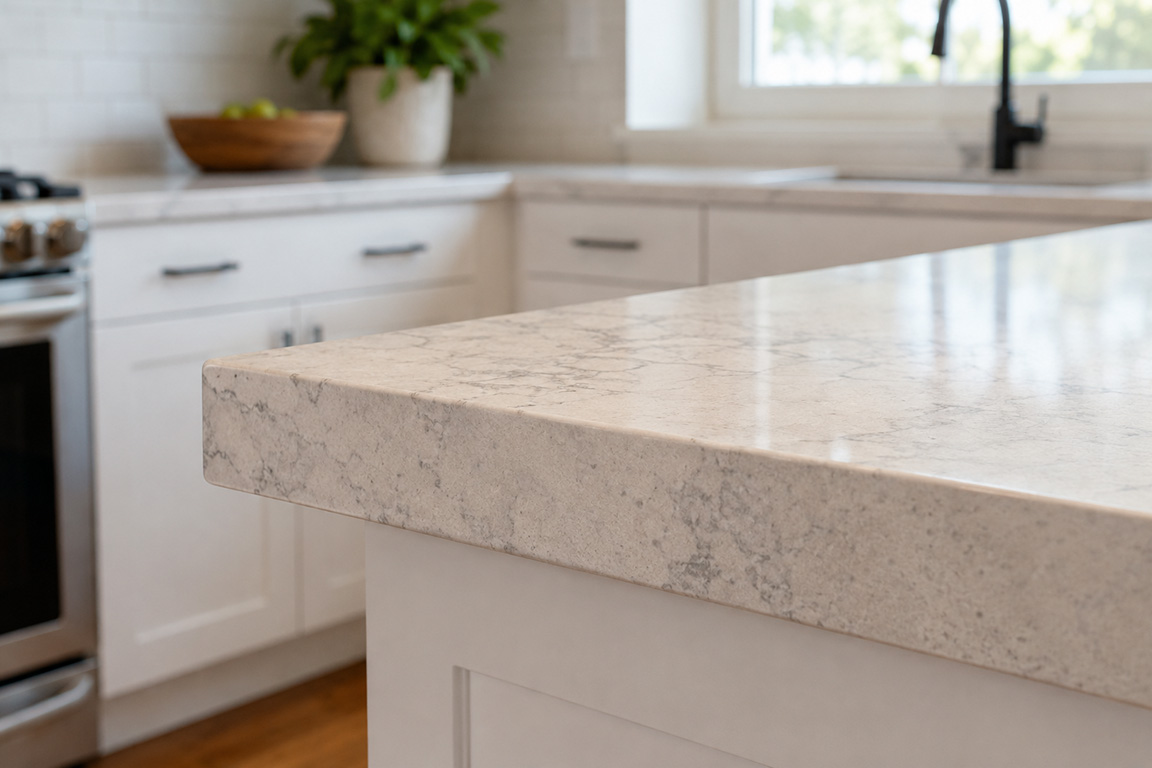
When most homeowners start researching countertop edge profiles, they’re surprised to discover just how much this one decision affects the finished look and daily function of their kitchen or bathroom. Most of the decision-making energy in a countertop remodel goes toward the stone itself — the color, the movement in the veining, the finish.
The edge profile is treated as an afterthought, something you pick from a laminated sheet at the end of the conversation. That’s a mistake. The edge is the first thing you actually touch every time you use your kitchen. It shapes how thick your countertop looks, how easy it is to wipe down, how safe it is for kids banging against the island, and whether the whole design feels finished or slightly off.
If you’re planning a kitchen or bathroom remodel in Denver, or anywhere along the Front Range, this guide covers every major edge option, when each one works best, how your countertop material affects your choice, and what most homeowners overlook when making this decision.
What Is a Countertop Edge Profile?
A countertop edge profile is the finished shape of the exposed edge of your countertop — essentially, what you see and feel along the front and sides of the stone after fabrication. Every countertop has one, whether it’s been deliberately chosen or defaulted to the shop standard. Profiles are cut and polished during fabrication using specialized tooling, and the complexity of the shape determines both the labor required and the final cost. Simple profiles require a single pass; more detailed, ornate profiles require multiple tooling changes and additional hand finishing.
Beyond aesthetics, your edge profile affects how easily crumbs and debris collect, how the stone reads visually in terms of thickness, and — as the National Kitchen and Bath Association recommends in its kitchen design guidelines — how safe your countertop corners are for households with children, since sharp 90-degree edges at counter height present a real impact risk.
The Most Common Countertop Edge Profiles
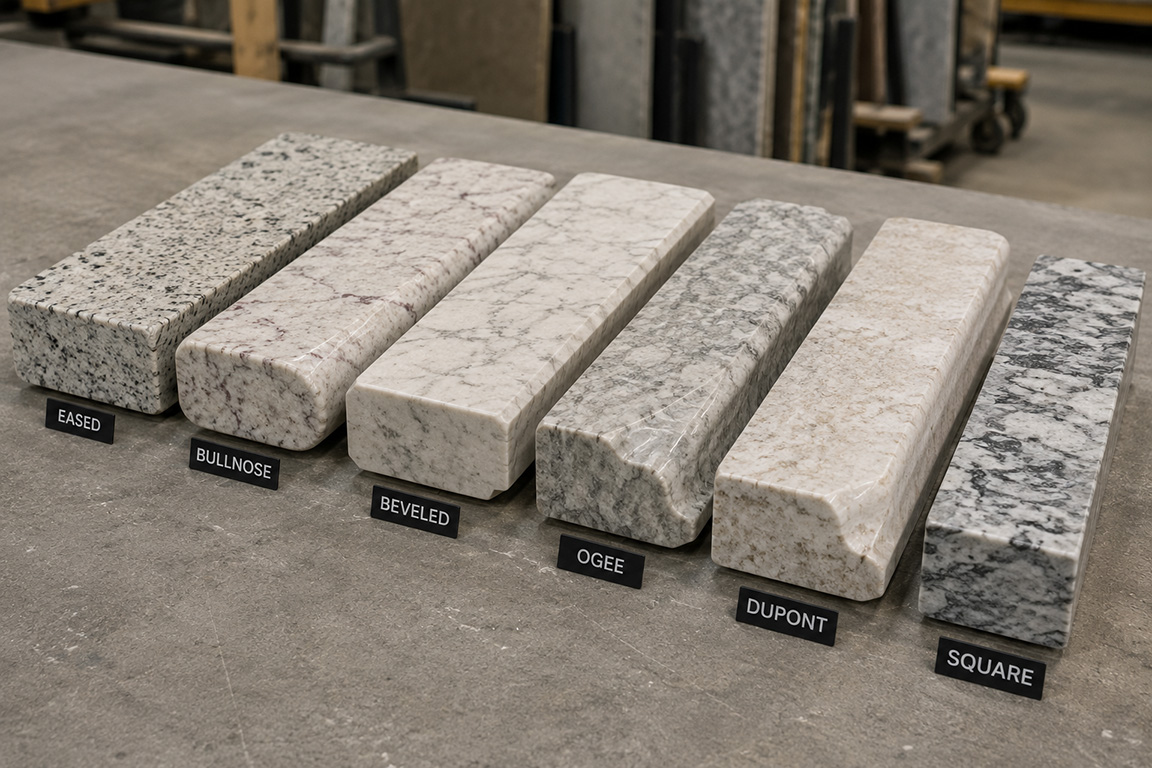
Straight Edge and Eased Edge
The straight edge — sometimes called a square edge — is exactly what it sounds like: a flat, unmodified 90-degree cut on all sides. It’s the most minimal option available and reads as sharply contemporary. The slightly eased edge takes that same flat profile and softens the top corner just enough to remove the hard right angle without rounding it. That subtle modification makes an eased edge more comfortable to lean against and reduces the risk of chipping over time, which is why it’s become the default in most residential fabrication shops.
Both the straight edge and the slightly eased edge are workhorse profiles in the countertop world. They’re clean, contemporary, and work in virtually every kitchen style — from a bright white modern build in Highlands Ranch to a transitional remodel in Wash Park. They’re also the easiest profiles to keep clean, since there are no crevices or curves where debris can collect. If you’re not sure what you want, or if your kitchen has strong design elements competing for attention — dramatic veining, bold cabinet color, statement hardware — an eased edge is almost always the right call. It gets out of the way and lets the stone speak.
Beveled Edge
A beveled edge takes the top corner of the countertop and cuts it at an angle, typically 45 degrees. It reads as slightly more refined than eased without committing to any ornamentation. Single-bevel profiles are clean and modern; a double bevel — with both the top and bottom corners chamfered — adds a little more visual weight and works well in transitional and contemporary settings. Bevels are popular in Denver new builds right now, particularly in open-concept kitchens where the island is a focal point.
Full Bullnose and Half Bullnose Edge
The bullnose edge, which can be either full or half, is fully rounded, providing a soft, classic look popular in traditional kitchens and very forgiving if bumped. The full bullnose rounds the entire top edge of the countertop in a smooth curve — it’s the softest, most approachable profile available. It has a long history in bathroom vanities and older kitchens and reads as warm and classic, which works well for certain design aesthetics. It can start to feel dated in modern kitchen remodels, and it’s worth knowing that rounded profiles tend to show wear and chipping more prominently on harder but more brittle stones — something to factor in if you’re working with certain granites or quartzites.
The half bullnose rounds only the top edge while leaving the bottom flat, which gives a lighter, more contemporary feel than the full version. It’s a practical middle ground if you like a soft edge but want something that pairs better with a modern cabinet line or thicker slabs, where a full bullnose can look heavy.
Waterfall Edge
The waterfall edge extends the stone vertically down the side of the cabinet run or island, creating a seamless, uninterrupted flow of material from the surface to the floor. Technically a design concept rather than a traditional profile, it requires precise mitering — two pieces of stone joined at a 45-degree angle — and demands careful grain or pattern matching on natural stone. It’s one of the most labor-intensive countertop details in residential fabrication, and it shows.
When done well on a dramatic quartzite or bold marble, a waterfall edge transforms a kitchen island into a furniture-grade statement piece that creates the illusion of a monolithic stone structure. Waterfall countertops were one of the major design highlights of 2025’s remodel season, valued for their seamless, architectural look. If your design vision includes a true showpiece island, this is the profile worth budgeting for.
Ogee Edge Profile
Ogee edges are defined by an S-shaped curve that adds elegance to traditional kitchens, but can be harder to clean due to dust and debris buildup in the concave section of the profile. The ogee is the most recognizable ornate profile — a shape rooted in classical architecture that has been a fixture in traditional and formal kitchen design for decades. It had a long run in the 1990s and 2000s, fell sharply out of favor during the minimalist wave of the 2010s, and is now showing signs of a revival among designers embracing more expressive aesthetics.
Homes and Gardens included the ogee edge profile in their 2026 kitchen design predictions as part of a broader return to crafted, architectural detail. If you choose it, go with a softer version and keep the surrounding kitchen relatively neutral so the edge has room to land.
DuPont Edge
The DuPont profile features a flat upper section with a small curved step down to a rounded lower edge. It’s a classic and graceful profile that has held up well in transitional kitchens — it has more personality than an eased edge without leaning into full ornamentation. It’s a solid choice for homeowners who want some visual interest without committing to the ogee’s formality.
How Your Countertop Material Should Influence Your Edge Choice
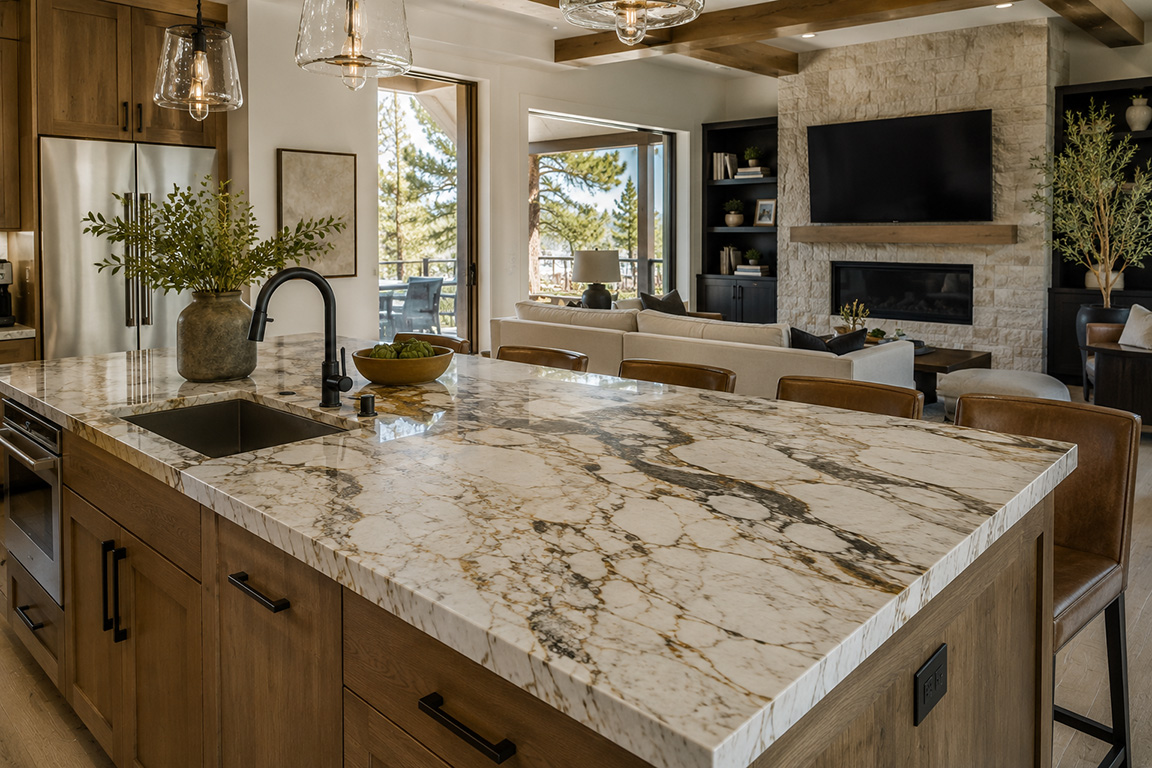
Your choice of material should factor heavily into which edge options make sense for your project. This is something most edge profile guides skip over entirely, but anyone who spends time in a fabrication shop understands it immediately — not every profile works equally well on every stone, and the wrong pairing can undercut an expensive slab.
Granite is dense and generally handles intricate profiling well, though some granites with heavy crystal structure or existing micro-fissures can be prone to chipping on delicate detail work. For most granite countertops, the full range of edge options is available, but eased and beveled profiles tend to show the stone’s natural beauty most cleanly.
Quartz is highly consistent in composition, making it well-suited for nearly any profile. Quartz countertops from premium brands like Cambria, which offers 19 different edge profiles, give you the most flexibility with predictable results across every custom application — there’s no variability between slabs to account for.
Quartzite is a natural stone with genuine hardness, but it can also have natural planes of weakness depending on the source. More intricate carved profiles carry some risk on certain quartzite varieties. For quartzite countertops with strong veining, simpler profiles often show the material’s character best anyway — a waterfall edge on a statement quartzite slab can be stunning, but a fussy ogee creates visual noise. If you’re drawn to a rustic, organic aesthetic, a chiseled or rough-cut edge on quartzite can look genuinely remarkable against wood cabinetry.
Marble is the most nuanced material for edge profiling. The stone is softer and more prone to chipping at thin edges, which is why bullnose and eased profiles are the safest bet for marble countertops. An ogee on a pure white Calacatta marble can look elegant in the right traditional kitchen, but you’re also exposing a fragile detail to daily contact.
Kitchen vs. Bathroom: Different Spaces, Different Priorities
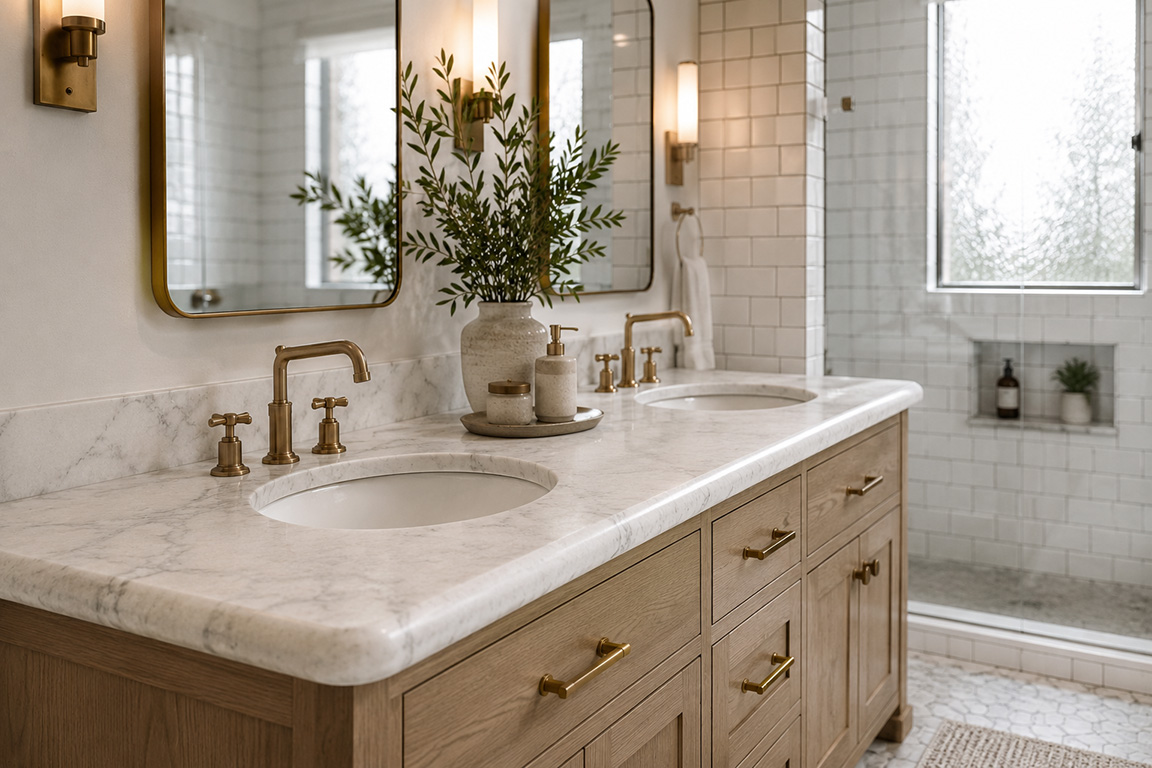
The kitchen and bathroom present entirely different edge-profile considerations, even when you’re using the same countertop material throughout the house.
In a kitchen — especially one with an island in a high-traffic area — your countertop edge is constantly touching bodies: hips leaning in while cooking, kids pulling up to eat, guests resting their hands during a party. The practical factors of cleanability and impact resistance matter more here than on almost any other surface in the home.
The NKBA specifically recommends clipped or rounded corners at counter height over sharp edges for exactly this reason. An eased, beveled, or half-bullnose edge handles the demands of kitchen life well. A deeply carved ogee or DuPont may look beautiful in a showroom, but will collect grease and require more deliberate cleaning in a working kitchen — function has to factor into the final decision.
In a bathroom vanity, the calculus shifts. Traffic is lower; wet hands and toothpaste are the main cleaning challenges rather than cooking oils, and aesthetics tends to take a more prominent role. Bullnose profiles work very well in bathrooms — the soft curve pairs naturally with the quieter, spa-like character most homeowners want in that space. An eased edge on a clean white quartz vanity looks sharp and contemporary. An ogee edge profile on a more traditional double vanity can work beautifully if the rest of the bathroom supports it.
Does Edge Profile Affect Price?
Yes, and understanding this before you finalize your budget makes the process smoother. Standard profiles — straight, eased, beveled, half bullnose, and basic DuPont — are typically included in base fabrication pricing or carry a minimal upcharge. More complex profiles that require multiple tool passes, hand finishing, or precise material matching command a higher labor cost. Your fabricator should be able to walk you through the price difference between standard and premium options before you commit to anything.
Waterfall and mitered edges are in a category of their own. Because they require an additional piece of stone, precise cutting, and careful seaming, they add meaningful cost to a project — the material itself doubles at the waterfall run, and the labor is significantly more intensive. On a large island in a luxury remodel, that premium is often well worth it. For new countertops on a more modest perimeter run, it may not be the right investment.
At Granite Direct, our fabrication and installation team handles all profiling in-house, so you’re not paying a third-party shop’s markup on edge complexity. Pricing for profiles is straightforward and explained during design, with no surprises at installation.
What Denver Homeowners Are Choosing Right Now
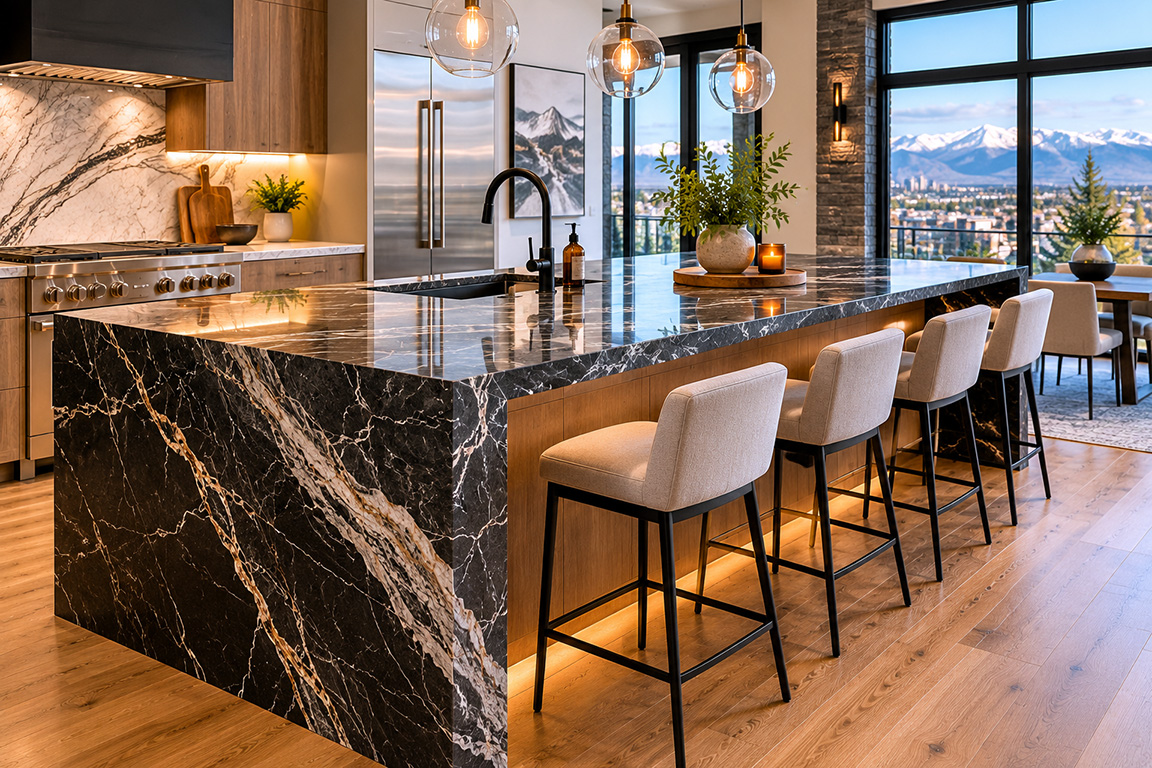
The Front Range remodel market has been moving clearly in one direction for several years: clean lines, organic materials, and edges that complement the stone rather than compete with it. Straight edge and eased profiles dominate new construction in Thornton, Westminster, and Centennial. Waterfall islands are a frequent request on higher-end kitchen remodels in Cherry Creek and Wash Park, particularly on quartzite and book-matched marble.
The ogee and DuPont are seeing renewed interest in renovations of older Denver homes where the traditional aesthetic is preserved rather than replaced — Tudor revivals, craftsman bungalows, and traditional colonials along the Front Range where ornate detailing suits the architecture. In those contexts, a more expressive edge makes sense and pairs naturally with wood cabinetry and rustic hardware to reinforce the home’s character.
The biggest shift we’re seeing in our Denver showroom is homeowners paying more attention to how the edge profile interacts with slab thickness. Thicker slabs — 3-centimeter stone — with a simple eased or straight edge make a strong visual statement on their own. A 2-centimeter slab often benefits from a mitered or stacked detail to create the illusion of greater depth and presence without adding stone weight.
How to Choose the Right Edge Profile for Your New Countertops
Start with your kitchen’s overall design direction, then work outward from there. Modern and contemporary spaces almost universally benefit from straight, eased, or simple mitered profiles. Traditional kitchens have more latitude for ogee edge profile detailing or DuPont. Transitional kitchens — the most common style in Denver metro remodels — tend to do best with eased or beveled.
Then look at your countertop material. Let it drive part of the decision. A quartzite with dramatic movement doesn’t need an ornate edge — it’s already doing the visual work. A simpler stone in a transitional kitchen might benefit from a DuPont or beveled edge to add character while staying within a reasonable budget.
Consider your household and how the space actually gets used. If you have young kids running the perimeter of your island in a high-traffic area, a softer edge is genuinely safer. If your kitchen is used primarily by adults who cook seriously, cleanability matters more than softness.
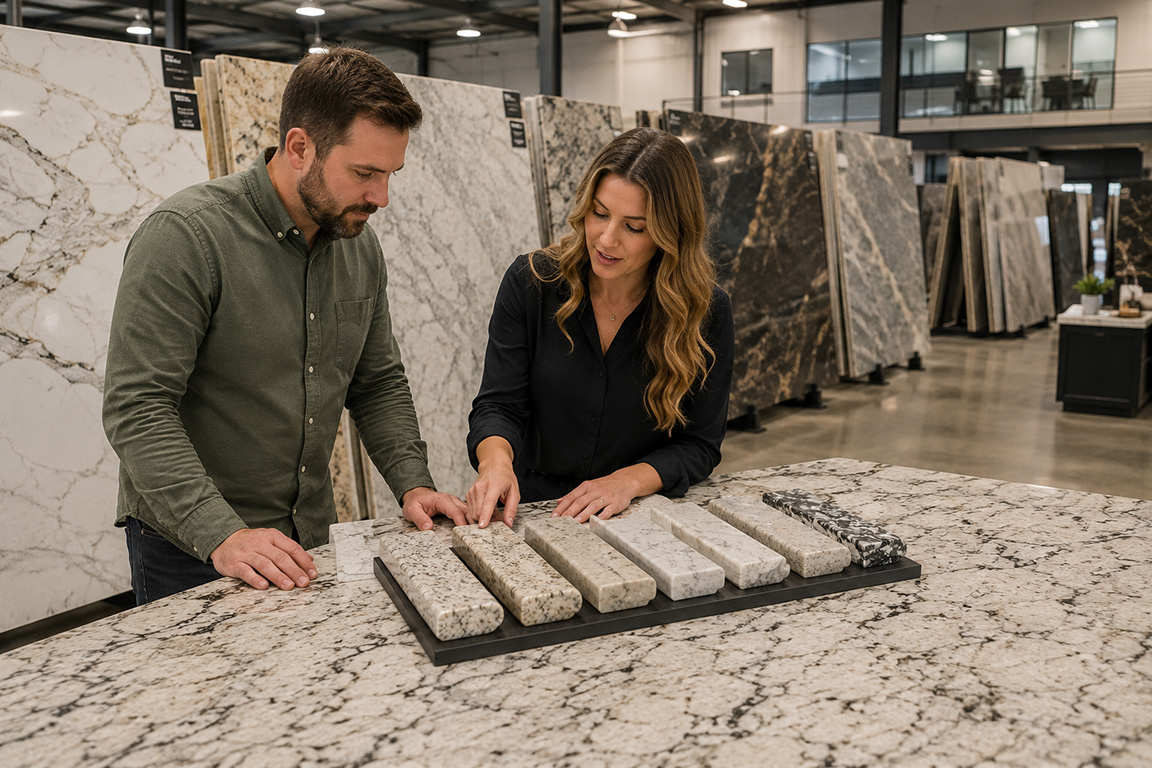
The best advice we can give: see the edge options in person on actual stone before you decide. Samples on paper or on a monitor look different from profiles cut into a real granite or quartzite slab. At our Denver showroom, you can search through edge samples alongside the slabs you’re considering and get a true read on how the profile will interact with your specific material. Our design consultants walk through this decision with every customer — it’s one of the more nuanced parts of countertop selection and deserves more than two minutes of attention at the end of a sales appointment.
If you’re ready to start narrowing down your choices, call us at (303) 282-8317 or stop by the warehouse to see what’s in stock.
Frequently Asked Questions: Countertop Edge Profiles
What is the most popular countertop edge profile?
The eased edge — a slightly eased variation on the straight edge — is the most widely used countertop edge profile in residential kitchens. It features a flat face with a softened top corner and works across virtually every design style. It’s also the most practical choice for high traffic areas because it’s easy to clean and holds up well over time.
Which edge profile is easiest to clean?
The straight edge and eased edge are the easiest to maintain. Both have flat surfaces with no grooves or crevices where crumbs, grease, or debris can accumulate. Profiles with carved details — ogee edge profile, cove, DuPont — require more deliberate cleaning along their curves and steps, particularly in working kitchens where cooking oils and food particles build up quickly.
Do edge profiles cost extra?
Standard profiles like straight, eased, and bevel are typically included in base fabrication pricing or carry a small upcharge. More complex edge options — ogee, DuPont, waterfall — involve additional tooling and labor and are priced accordingly. The waterfall edge also requires additional countertop material, which increases the total budget. A good fabricator will walk you through the cost of each profile before you finalize your design vision.
What edge profile works best for granite countertops?
Granite handles a full range of edge options well. For most kitchens, an eased or beveled edge lets the stone’s natural character show without distraction. Waterfall and mitered edges on statement granite slabs can be striking, and thicker slabs — 3 centimeters — support more detailed profiling. Highly intricate profiles, such as a deep ogee, are possible but carry a risk of chipping, depending on the specific granite’s mineral composition and structure.
Can I see countertop edge profiles in person before deciding?
Yes — and you should. Granite Direct’s Denver showroom has edge samples you can view and touch alongside actual stone slabs. Seeing a profile cut into the specific countertop material you’re considering gives you a much more accurate read on your design vision than any photo or digital rendering. Stop by or call (303) 282-8317 to schedule a visit.